


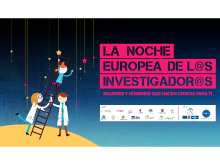
Once again this year, researchers from cicCartuja will participate in the European Researchers’ Night, an initiative promoted by the European Commission within the framework of the Horizon 2020 programme. This scientific dissemination event will take place simultaneously in more than two hundred and fifty cities in Europe on Friday 28 September 2018. In Seville, the Spanish National Research Council (CSIC), the University of Seville (US), the Pablo de Olavide University (UPO) and the City Council of Seville, among other institutions, have joined forces to offer a programme consisting of workshops, micro-meetings and shows. The aim is to foster a rapprochement between citizens and the scientific community in a relaxed atmosphere and through informative and practical language.
The unique format of this initiative allows citizens to learn more about the work carried out by researchers and to overcome some of the stereotypes that weigh on them. Researchers, for their part, are given the opportunity to demonstrate that they are not oblivious to the reality outside their laboratories.
The micro-meetings in which the researchers will participate will be structured around a talk where various concepts will be introduced and discussed with the public, using examples from recent research.
Below are more details about these micro-meetings that the cicCartuja researchers will offer:
Controlling light at the nanoscale
Juan Francisco Galisteo López (ICMS)
Location: Apeadero Hall, City Hall. Opposite Plaza Nueva
Time: 18.00
Value of the research: Nanostructured optical materials find applications in various fields such as energy (solar cells), medicine (UV radiation protectors) or lighting (LEDs). Being able to control how light propagates or the way we generate it is essential for various applications such as telecommunications or lighting. Nanotechnology offers us a way to carry out this control using materials that have been artificially structured on a scale similar to the wavelength of light. In these “nanostructured” systems, the interaction between light and material has a particular behaviour, which we do not observe in conventional materials.
In this talk we will talk about how this structuring helps us to control light. We will also show how we can design and manufacture nano-structured materials in our laboratories from nanoparticles and what applications we can develop at present and which we hope to achieve in the future. We will see that nano-structured materials are present in some animals and plants and that they will also play an important role in fields such as photovoltaics or lighting.
Food allergy: design of new vaccines
Javier Rojo (IIQ)
Location: Apeadero Hall, City Hall. Opposite Plaza Nueva
Time: 19.00
Value provided by research: This research allows relatively easy access to compounds that can be used for immunotherapy in allergic processes. The prepared compounds not only protect, but also induce tolerance in these allergic processes, as has already been demonstrated in mice. The model developed for peach allergy can be extrapolated to other allergy models simply by selecting the appropriate peptide. In this way, the developed strategy opens the doors to the development of new vaccines against different allergies, with a high impact in the field of health and the consequent benefit for society, reducing the impact that food allergies have on the lifestyle of allergic people.
Take the colour of plants with you
Irene García, Vicente Mariscal and Luis Heredia (IBVF)
Place: Rosalind Franklin Space. CSIC tent. Plaza Nueva
Time: 11:00 p.m.
Value provided by the research: Photosynthesis is a surprising biological process: water and carbon dioxide are transformed into biomass thanks to the energy of light. All organisms depend on this process, as it is the basis of the primary production of food, and therefore it can be considered to be the beginning of the life cycle. In addition, photosynthesis produces the oxygen we breathe and consumes carbon dioxide, one of the gases responsible for the greenhouse effect. Understanding the importance of photosynthesis is accepting that all living beings are deeply related in a perfect but fragile balance. Their study can contribute to addressing the challenges presented by the sustainable production of energy and food, especially in the face of the threat posed by climate change.
Microalgae from evolution to the table
Inmaculada Couso Liañez (IBVF)
Location: European Corner, Plaza Nueva, Seville
Time: 19.00
Summary of the activity: The talk will focus on green microalgae or chlorophytes and how they constitute the evolutionary origin of plants. It will also explain how the research carried out in the laboratory aims to increase the degree of knowledge of the enormous biotechnological potential of these microorganisms that are beginning to be used more commonly in different products that we consume daily.
Use of plant biotechnology as a tool to increase agricultural production
Emilio Gutiérrez Beltrán (IBVF)
Location: Apeadero Hall of the City Hall. Opposite Plaza Nueva
Time: 21.00
Summary of the activity: According to forecasts by the FAO (Food and Agriculture Organization of the United Nations), in 2050 the world population will have grown by around 34%, so it is expected that to meet the demand of the population, an increase in agricultural production of 70% will be necessary. The talk aims to show the tools through which plant biotechnology aims to be the main way to face this great challenge of society.
Diamond, graphite and graphene… are they related?
Rosalía Poyato Galán (ICMS)
Location: Rosalind Franklin Space. CSIC tent. Plaza Nueva
Time: 19.00
Summary of the activity: Graphene is one of the allotropes of carbon like graphite, diamond, fullerenes or carbon nanotubes. It consists of a single layer of carbon atoms in the form of a two-dimensional hexagonal tessellation (like a honeycomb). This material was first synthesized in a laboratory by Geim and Novoselov in 2004 and since then it has aroused great interest in the scientific world due to its exceptional mechanical and thermal properties, as well as the exceptional mobility of electrons on its surface.
This activity consists of an interactive workshop in which children and young people will be introduced to the different allotropes of carbon, establishing the similarities and differences between them and relating carbon nanostructures (fullerenes, nanotubes, graphene, graphene nanosheets…) with other better-known carbon materials such as diamond and graphite. Once the different materials have been presented, the audience will be divided into groups, and each group will tackle the assembly of one of the molecular structures
Molecules that transform molecules
Jesús Campos (IIQ)
Location: European Corner tent. Plaza Nueva
Time: 23.00
Summary of the activity: In this informative conference, basic concepts of chemistry will be brought closer to the general public, showing the presence of this science in all aspects of our daily lives. Experiments will be carried out to differentiate chemical reactions from physical processes and the concept of catalysis will be presented, that is, molecules that transform molecules. Catalysis is present in most industrial chemical processes, in the development of new drugs and new materials, in many of the chemical reactions that take place inside our body, etc. The objective of this micro-meeting will be to clearly explain the fundamentals of catalysis and demonstrate its usefulness with experiments carried out during the activity.