For years, the figure of Maria Sklodowska, Marie Curie (Warsaw, Poland, 1867 – Passy, France, 1934), has been distorted by commonplaces about her work and personal life. In scientific history textbooks, films and media articles, she has generally been portrayed as a woman marked by sadness, mourning and social adversity.
Now, a biography by Adela Muñoz Páez, Professor of Inorganic Chemistry at the University of Seville and researcher at the Institute of Materials Science in Seville, revises the clichés surrounding Marie Curie. The book Marie Curie. La radioiactividad y los elementos (El secreto mejor guardado de la materia), published by RBA in the collection ‘Grandes ideas de la ciencia’, attempts to describe her professional and human trajectory from a new, more vitalist perspective, in which, according to the author, the ‘passion’ with which she developed her scientific curiosity and with which she educated her daughters stands out.
Beyond her scientific achievements, the discovery of radioactivity and the two Nobel Prizes, this biography shows Marie Curie as a fighter who dedicated herself to research ‘to the limit of her strength’ and who reached unthinkable heights for women of her time, such as becoming the first professor in the more than 600-year history of the Sorbonne University. Adela Muñoz also explores Marie Curie’s relationship with her husband, the physicist Pierre Curie, with whom she formed ‘one of the most fruitful working teams in the history of science’, despite the fact that he was relegated to a ‘secondary position’ within the French scientific community.
Research and popularisation of science
Born in La Carolina (Jaén), Adela Muñoz Páez has combined a dual role in the field of science throughout her career, either as a teacher (she is Professor of Inorganic Chemistry at the University of Seville and a researcher at the Institute of Materials Science in Seville, of which she was Vice-Director from November 1998 to January 2010) or as a disseminator of scientific results, especially those obtained by women.
Initially trained in Solid State Chemistry and Heterogeneous Catalysis, Adela Muñoz specialised in X-ray Absorption Spectroscopy for the study of solids and solutions. Her research led her to radiation sources in Great Britain, France and Japan, where she has participated in international projects. She has developed specific techniques for the study of surface layers, in particular ReflEXAFS, and has identified the structure in solution of numerous metal cations.
At the same time, she has also worked on a productive line of study in the field of the history of science. As a science populariser, she has collaborated in the magazines Redes and Maginaria, and in newspapers such as Diario de Sevilla, El Mundo and, recently, El Huffington Post. For several years, Adela Muñoz has maintained a website, Cartas a Hypatia, in which she reviews the biographies of historical women scientists and vindicates the role played by women in research. Her books include the essay Historia del veneno. De la cicuta al polonio (2012), which is now joined by the biographies Marie Curie. Radioactivity and the Elements and Lavoisier, the Father of Chemistry.
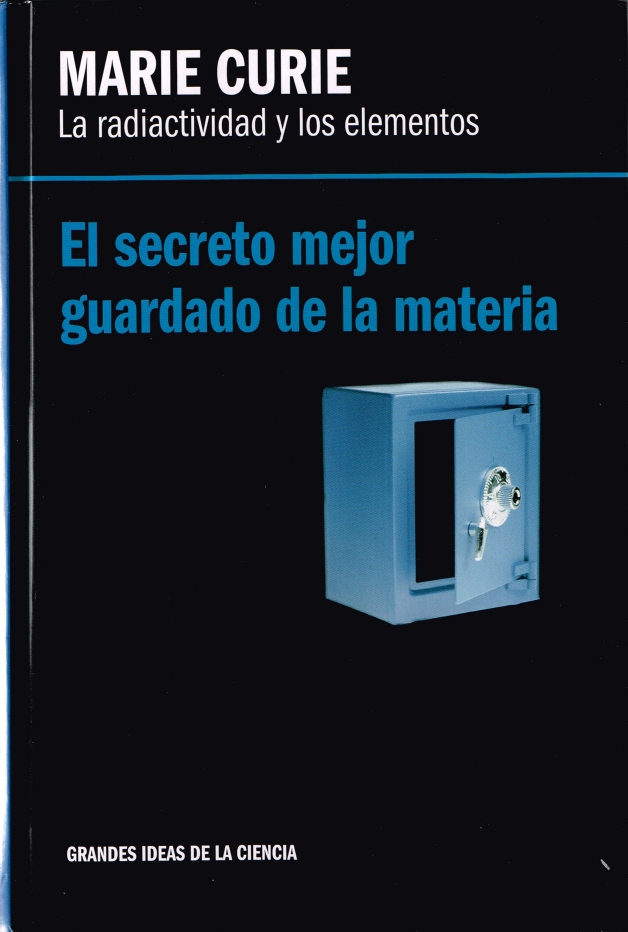
Adela Muñoz Páez publishes a biography that subverts clichés about Marie Curie