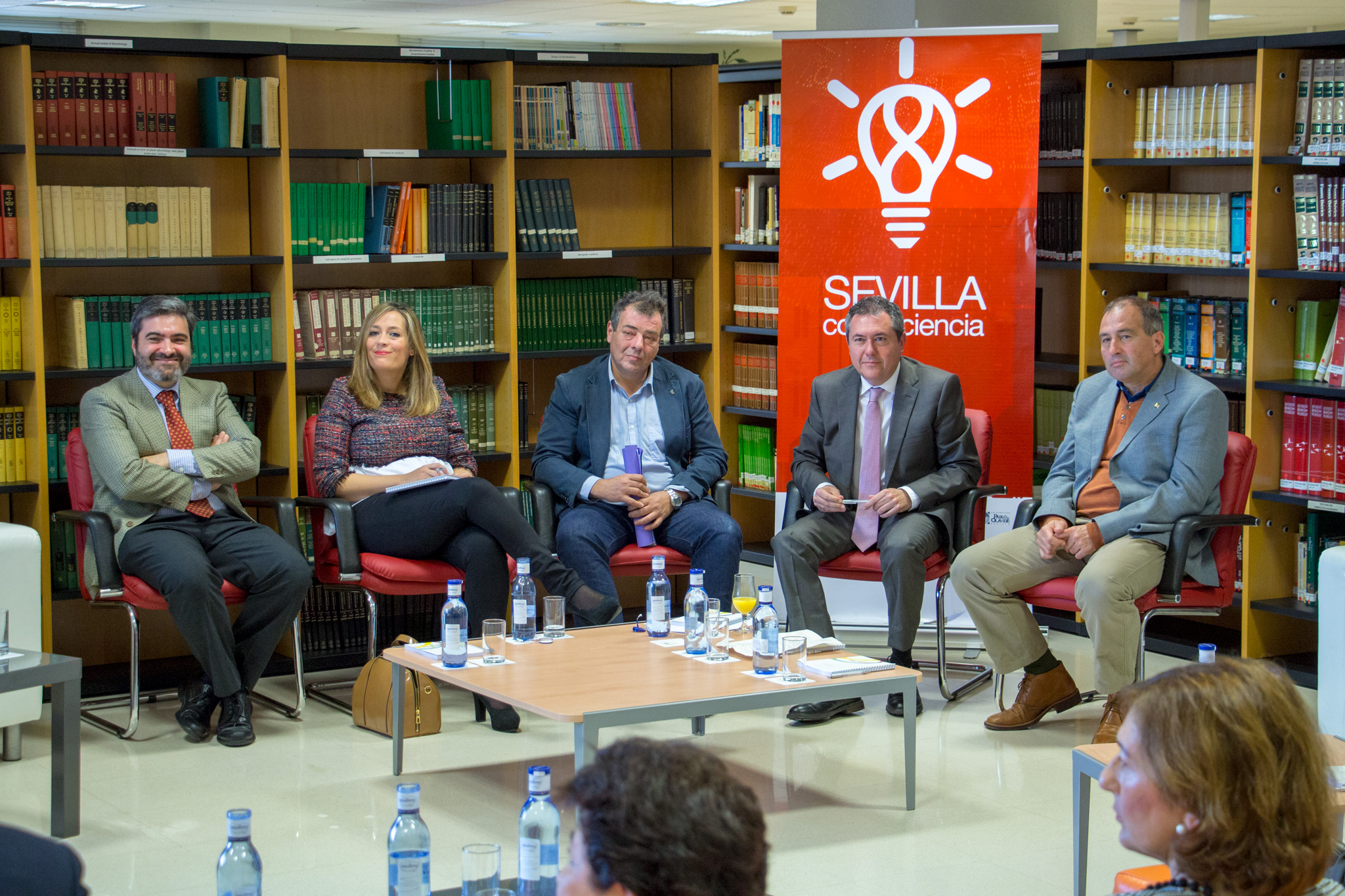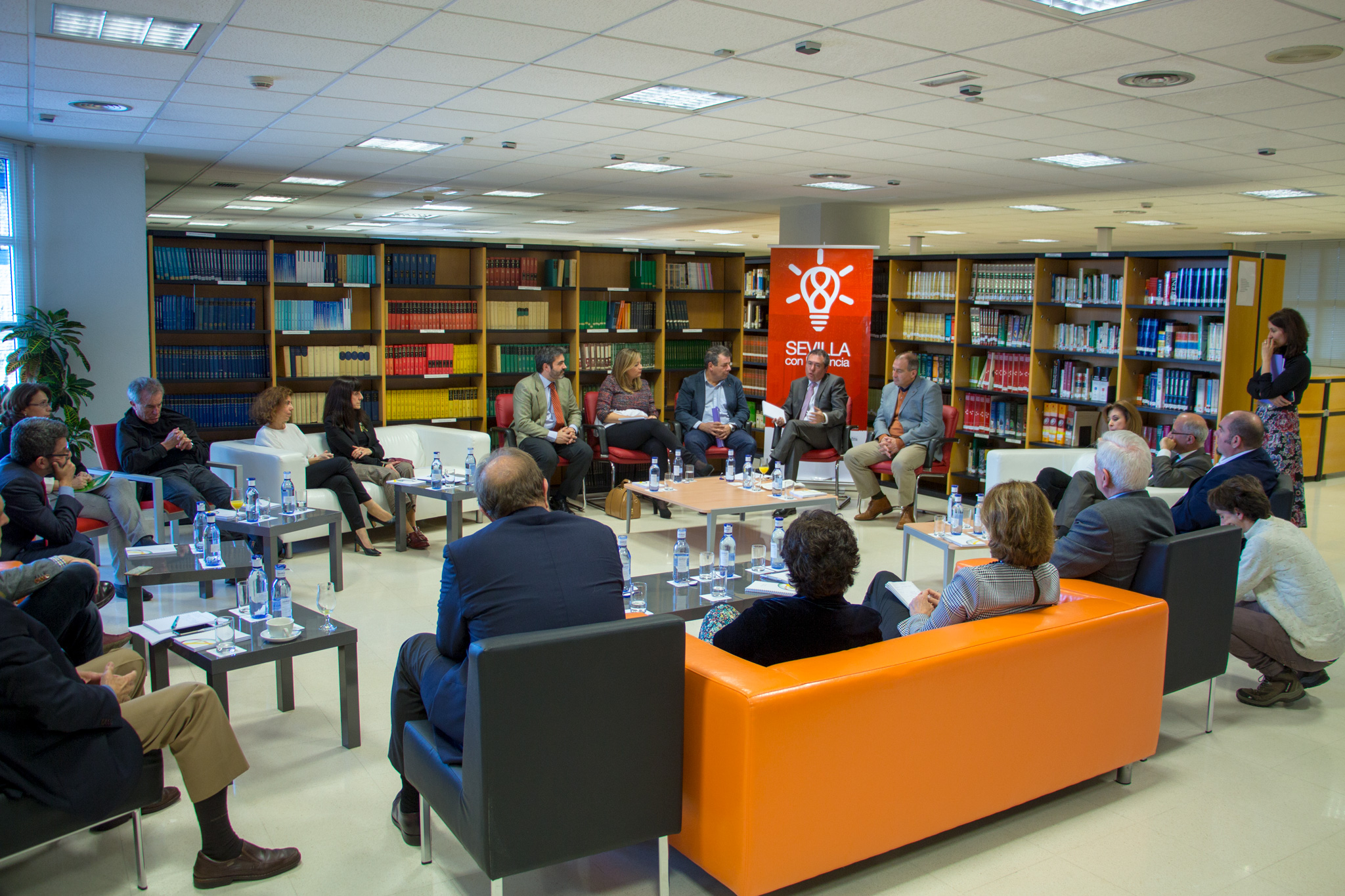
Seville, March 5, 2018. The Mayor of Seville, Juan Espadas, and the Delegate for Equality, Youth and Relations with the University Community, Myriam Díaz Rodríguez, held a meeting today with the main institutions that carry out public research in the city – the Higher Council for Scientific Research (CSIC), the University of Seville (US) and the Pablo de Olavide University (UPO) – and a group of fifteen researchers with extensive experience in R&D in the city. During the meeting, which took place at the Isla de la Cartuja Scientific Research Centre (cicCartuja), data on R&D from the public sector in Seville were presented and the strengths of public science in Seville were jointly addressed, as well as some of its weaknesses.
At this event, the institutions were represented by Miguel Ferrer, institutional delegate of the CSIC in Andalusia; Bruno Martínez, vice-rector for Research and Technology Transfer at the UPO; and Ricardo Chacartegui, director of the Secretariat for the Promotion of Research and Scientific Culture of the US. Likewise, the researchers invited to the same belong to the three institutions mentioned and have been Javier Rojo, from the Institute of Chemical Research (IIQ/CSIC) and current director of cicCartuja; Asunción Fernández, from the Institute of Materials Science of Seville (ICMS/CSIC); José Luis Gómez-Skármeta, from the Andalusian Center for Developmental Biology (CABD/CSIC); Rosa Ríos, from the Andalusian Center for Regenerative Biology and Biomedicine (CABIMER/CSIC); Pilar Ostos, from the Department of Medieval History and Historiographic Sciences and Techniques of the US; Alejandro Conde, from the Department of Condensed Matter Physics of the US; Francisco Javier Pérez Royo, from the Department of Constitutional Law of the US; Federico París, from the Department of Continuum Mechanics and Theory of Structures of the US; Ana María Troncoso, from the Department of Nutrition and Bromatology, Toxicology and Legal Medicine at the US; Sofía Calero, professor of Physical Chemistry at the UPO; Agnès Gruart, professor of Physiology at the UPO, Manuel González de Molina, professor of Contemporary History at the UPO; Juan Manuel Cortés, professor of Ancient History at the UPO; Fátima Navas, professor of Physical Geography at the UPO; and José Luis de Justo Alpañés, president of the Royal Seville Academy of Sciences (RASC).
According to the mayor of Seville, Juan Espadas, the objective of this meeting has been to value and make visible the science that is done in the city of Seville. “I am absolutely committed to changing the way of thinking about this city,” said Espadas. He also added that one of the tasks of the City Council in this regard could be to participate together with the institutions present at the event, CSIC, UPO and US, in international spaces of science and technology.
Miguel Ferrer, researcher and institutional delegate of the CSIC in Andalusia, stated that his institution maintains a close relationship with the city, not only because of the high number of research centres affiliated in the capital of Seville, but because, for example, the US is the Spanish university with which the CSIC maintains a greater number of mixed centres. He recalled that in addition to research, the CSIC is committed to scientific dissemination in Seville through the activity that takes place in the Museum Casa de la Ciencia.
For his part, Bruno Martínez, vice-rector of Research at the UPO, recalled that his university is the most recent in the city and in it the young generations of researchers have had an enormous responsibility in its construction and attracting projects. “The City Council can collaborate in the participation of network projects in the field of the European Union,” he added. He stressed that the lobbying that the City Council can do to establish links between Seville and other cities in the field of science is very important.
Ricardo Chacartegui, director of the Secretariat for the Promotion of Research and Scientific Culture of the University of Seville, recalled that the University of Seville, with seventy thousand members, is totally involved in the research that is done in the city. He also pointed out that a stable and recognizable scientific career is necessary, especially for the next generations of young researchers.
Federico París Carballo, professor at the US School of Engineering, stressed the importance of teaching children about the main milestones in science and technology in the city.
Public R&D data in Seville
Although it has always been pointed out that quantity is not synonymous with quality, numerical data can be used to draw a dimension of the weight of science in the city. In this sense, the Higher Council for Scientific Research (CSIC), adding the funding from national projects of the State Plan and regional and international projects, reached nearly 35 million euros dedicated to science in its centres and institutes in Seville, according to data extracted from the 2016 Report (http://bit.ly/1o7cFeF) of the institution itself.
For its part, during the 2016/2017 academic year, the Pablo de Olavide University (UPO) invested nearly 30 million euros in research activities, adding national and international funds. Specifically, 20.67 correspond to projects carried out that year and another 8.54 to international projects that are still being carried out, as indicated in the latest research and technology transfer report (http://bit.ly/2t5XSyu) of this study center.
Likewise, the University of Seville (US) dedicated more than 32 million euros to research in 2016 from the State Plan, regional plans, international projects, contracts with other entities, and its own research plan, according to the 2016 Report (http://bit.ly/2HYnjFI) of its Vice-Rectorate for Research. These data do not include the investment in infrastructure or human resources made by the US. It is pertinent to point out that the IUNE 2017 Report on the research activity of Spanish universities places this university in fourth place at a national level in total income in R&D&I, with an amount in the last five years of almost 60 million euros.
It should be noted that each institution prepares its statistical reports independently, taking into account and including the parameters it deems appropriate, so some data are not entirely suitable for comparison; however, it could be estimated that public R&D&i in the city of Seville moves an annual amount close to 100 million euros. An amount that allows some 8,000 people from the CSIC, US and UPO to develop their projects, including professors and scientists on staff, PhDs contracted for specific projects, technicians, management and administrative staff, as well as students in pre-doctoral training.