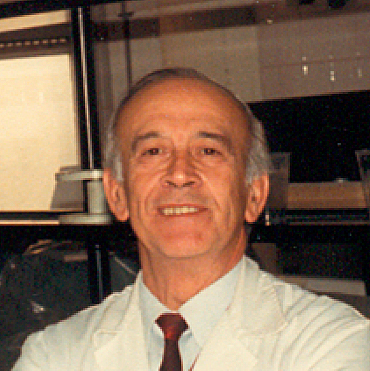
On February 25th, at the age of 92, Don Antonio Paneque died. He left an indelible mark on the Institute of Plant Biochemistry and Photosynthesis, the Joint Center of the CSIC and the University of Seville that he helped to found and served until his retirement as a Research Professor at the CSIC. In the last years of his life, Don Antonio’s memory had abandoned him. The last time I saw him and he recognized me was at the funeral of Efre, his wife, his inseparable lifelong companion. It was also the only time I saw Don Antonio truly dejected.
Don Antonio Paneque graduated and received his PhD in Chemistry from the University of Seville. In the late 1950s, as an Assistant Professor of Organic Chemistry, instead of following a more or less comfortable and predictable career in the Spanish University of the time, Don Antonio made a bold decision. He changed his area of research to devote himself to Biochemistry, a science that had already achieved great achievements internationally, but was still in its infancy in Spain. To do so, he joined the group of Prof. Daniel Arnon at the University of California at Berkeley, one of the great centres of excellence in Biochemistry at that time. At this University, where the cyclic pathway of photosynthetic carbon dioxide fixation had just been unravelled – for which Calvin received the Nobel Prize in 1961 – Don Antonio actively participated in transcendental discoveries of the process of photosynthesis, whose complex mechanism was being deciphered at that time. It was there that he met Prof. Manuel Losada, with whom he would share his scientific career.
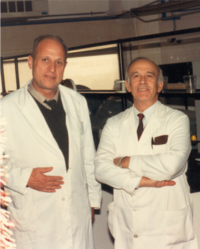
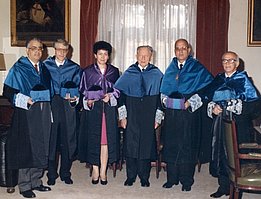
Back in Spain, Don Antonio first joined the Centre for Biological Research in Madrid and, in 1967, moved to Seville, with the creation of the Department of Biochemistry at the University of Seville, which is the origin of the current Institute of Plant Biochemistry and Photosynthesis. During these years, Don Antonio participated in the development of the line of research on the photosynthetic assimilation of nitrogen, a line that gave rise to contributions of extraordinary relevance, which were published in international journals of the highest prestige. These were the times of the founding of the Spanish Society of Biochemistry, of which Don Antonio was the third member. They were, therefore, the times of the pioneers of Biochemistry in Spain, to which they knew how to give an air of modernity in open contact with the science that was being done outside our borders, something decisive for the extraordinary rise that Biochemistry has had in the Spanish scientific field.
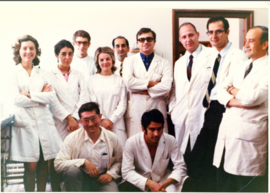
Don Antonio was not very fond of management tasks, he always preferred to work in the laboratory. Therefore, his contribution to the scientific training of the promotions of biochemists who left the Department in those years was enormous. He was especially gifted for this task because he was an affable and tolerant person, who knew how to create a cordial atmosphere in his environment. He always maintained his unmistakable air of deceptive formality, his tie perfectly knotted, his lab coat always on. With that formal air he looked with understanding and amusement at the changes in appearance and ways of thinking of the new generations who joined the Department, to whom he was so receptive. I have the honour of being one of those disciples, since Don Antonio was the director of my doctoral thesis. I know for this reason the indelible memory that his beloved figure leaves in all of us who pass through his laboratory, the unforgettable 108.
In the future of research centres, the founding effect is of decisive importance. Those of us who joined later are already part of a certain idea, of a way of doing research, which remains intangible over time. That Department of Biochemistry benefited from the extraordinary scientific figure and human quality of Don Antonio Paneque, to whom the current Institute of Plant Biochemistry and Photosynthesis will always have an enormous debt of gratitude.
Francisco Javier Cejudo Fernández
Director of the Institute of Plant Biochemistry and Photosynthesis