


The study on the response of cells to DNA damage, led by Professor Irene Díaz Moreno, Professor at the University of Seville and head of the Biointeractomics group at the IIQ, has obtained funding from the Areces Foundation. It has been selected, along with 21 other projects, in the “XX National Competition for the award of Research Grants in Life and Matter Sciences (2020 call)” of the Foundation.
The work of the Biointeractomics group delves into the bidirectional communication between the nucleus and the mitochondria, breaking with the paradigm that considers the cell as a compartmentalized structure in which each compartment – that is, each organelle – performs a function organized and directed by the cell nucleus. According to the classic and hierarchical view of cellular organization, the nucleus would constitute the control room where decisions are made and the functioning and development of cellular metabolism is decided. These nuclear orders are executed by proteins present in the organelles, including the mitochondria as the energy centre of the cell. However, this model leaves two questions in the air: is there only one-way communication between the nucleus and the organelles, and specifically between the nucleus and the mitochondria? And what happens in the event that the nucleus is damaged and cannot send orders or messages to the organelles?
Previous results from the group led by Professor Díaz Moreno show that the cell is not made up of sealed compartments, which only receive information from the nucleus, but that there is an interconnection between them and allows the state of one organelle to affect the functioning of another; or that they work together to carry out the same cellular function. It is true that science has found organic and inorganic molecules that act as messengers in intracellular communication, but more recently it has been shown that proteins can also perform these signalling functions. One of these proteins is cytochrome c, which is normally found in the mitochondria and participates in obtaining energy. This small protein, under certain stimuli, is capable of leaving the mitochondria and triggering the so-called programmed cell death, a mechanism by which a cell that has suffered various damages decides to end its existence in favor of the survival of the rest. In addition, cytochrome c is even capable of traveling to the nucleus where it facilitates the repair of DNA (a molecule that contains the genetic information that governs our entire metabolism), showing that the communication between the nucleus and organelles is not only unidirectional and that certain proteins are capable of participating in decision-making in response to damage to nuclear DNA. This ability of proteins to play different roles depending, among other factors, on cellular location is what is known in English as the “moonlighting protein,” and cytochrome c is a clear example of this and the main object of study of the selected project.
This project is an innovative study that highlights the importance and multifunctional role played by certain proteins with such diverse functions that vary from organizational and decision-making to merely executive functions dictated by the nucleus.
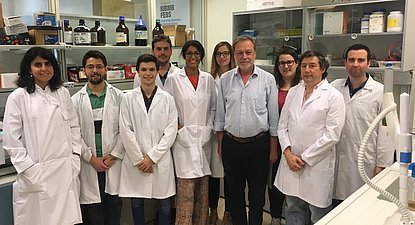
The Biointeractomics group